Bulgarian team makes historic breakthrough in robotics at global scientific forum CoRL 2025


Change language: N. Macedonia Romania Serbia
Bulgarian scientists have achieved impressive success on the world stage after a development by the Institute of Computer Science, Artificial Intelligence and Technologies (INSAIT) at Sofia University "St. Kliment Ohridski" was accepted for presentation at the prestigious Conference on Robot Learning (CoRL) 2025. The forum, which is a leading event in the field of robotics and artificial intelligence, was held from September 27 to 30 in Seoul, South Korea, BalkanEngineer.com learned from a press release from the institute.

The INSAIT team presented its innovative MotoVLA model—a new method that allows robots to learn not only from specially prepared engineering data, but also from ordinary video recordings from the real world. Similar to the way children learn through observation, the technology enables robots to independently analyze movements and actions to acquire new skills without additional labels or instructions.
The research is the work of Alexander Spiridonov, Dr. Jan-Nico Zech, Nikolay Nikolov, Prof. Luc Van Gul, and Dr. Danda Pani Paudel, who are applying a new approach to processing three-dimensional data from points generated from video footage. This allows robots to adapt to new tasks more intuitively and with less prior training, significantly reducing the need for expensive demonstration data sets.
The results show that MotoVLA outperforms existing models in terms of efficiency and flexibility. In the SIMPLER simulation, the method achieves an average success rate of 68.2%, which is 14.1% better than the previous leading model, LAPA. In real-world tests on eight different tasks, the Bulgarian development demonstrated direct knowledge transfer from unlabeled videos to real-world applications, such as pressing buttons or moving objects.
Along with scientific recognition, INSAIT was one of only two teams in the world selected to participate in RoboArena, an international challenge organized by Stanford University, the University of California, Berkeley, and other leading scientific institutions. There, the Bulgarian model successfully competed with solutions trained with ten times more data, including pi0 – a development by the start-up company Physical Intelligence, funded by Jeff Bezos and OpenAI.
"For us, this is an honor and a huge step forward. We are showing that in Bulgaria we can do science and technology at a world-class level," commented the authors of the development.
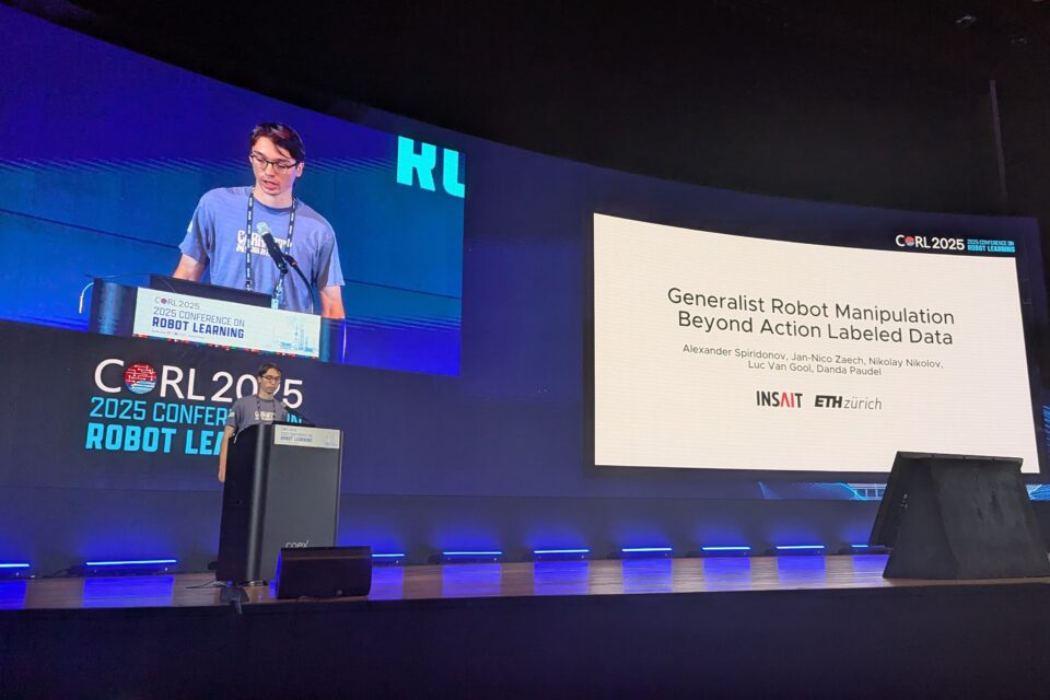
Photo source: INSAIT, ©Engineer BG via Canva.com