Hexonic offers multi-section and stainless steel heat exchangers that contribute to the profitability and standards of the food industry


Change language: Bulgaria Romania Serbia
“The game” with temperature is key for most processes in the food industry. From warming and cooling raw materials to keeping precise temperatures for their storage and transportation – the optimal values on the thermometer are a deciding factor for the quality of the final product. At the same time the industry is seeking ever more effective processes, and the users, being ever more informed, place high expectations on food and drink. All of this puts heating technology on a pedestal. "Food manufacturers are constantly investing in new, efficient solutions with high quality and reliability. And we are able to offer a variety of heat exchange solutions that meet the standards of the food industry," Hexonic, a proven heat exchanger manufacturer, told BalkanEngineer.com.

The wide range of heat exchangers offered by Hexonic is designed in such a way that it rationalizes processes such as heating, cooling, pasteurizing, and cleaning in place (CIP), while at the same time conserving energy and helping maintain hygiene. The main product groups, offered in the food sector, include multi-section plate heat exchangers and stainless steel heat exchangers that perform various tasks in process lines.
Heat transfer in dairy processing
Typical of the dairy industry is the need for careful processing of the raw material, so that it can be utilized to the maximum extent without compromising the quality of the final product. A common process is pasteurization - a low-temperature thermal treatment, through which the pathogens in milk are reduced to a minimum.
"In the context of dairy processing, JAG plate heat exchangers serve as pasteurizers. They help heat the milk to a temperature of 74 °C – 95 °C, depending on the product, and hold it at this temperature for 15 – 20 s before cooling it to the packaging temperature, around 4 °C – 5 °C, or the fermentation temperature, 25 °C – 42 °C. JAG also serves as a cooler in the system,” explained Hexonic.
Operating parameters of JAG stainless steel plate heat exchangers:
- Maximum operating temperature: 170 °C;
- Minimum operating temperature: -20 °C;
- Pressure: 6, 10, 16, 25, 30 bar.
Heat exchangers for the brewing industry
For a traditional occupation, brewing has become a high-tech automated industry due to modern technical capabilities that greatly optimize productivity, efficiency and product quality.
Regarding the needs of the brewing sector Hexonic offers:
- JAG F stainless steel heat exchangers – plate and detachable;
- JAD shell and coil heat exchangers;
- COOL dry coolers;
- L series brazed plate heat exchangers.
Optimal heat exchange for efficient beverage production
Precise temperature control plays a key role in the production of drinks, where water, acting as the base, and the different syrups and additives, proceed through warming and cooling until the final product is complete. "Glycol is usually used as a cooling agent, and optimal heat exchange with low pressure losses can contribute to reducing operating costs, which is extremely important in mass production," Hexonic explained.
For this part of the food industry Hexonic offers reliable heat exchange systems, necessary for the pasteurizing, cooling and warming of juices, water, as well as the CIP processes. The company offers:
- Plate and split heat exchangers JAG F;
- JAD shell and coil heat exchangers.
Sugar production technology and the role of heat exchange
Initially, sugar cane and sugar beets undergo special processing, and the raw sugar syrup is filtered to remove large particles. What follows is a heating process of around 50 – 85 °C to clarify the liquid as much as possible. This can happen in a plate heat exchanger (Hexonic's JAG for example). After that, the juice is transferred into a different plate heat exchanger (a possible variant is JAG F), which serves as an evaporator and increases the efficiency of the system. The process ends with heating in another heat exchanger to ultimately produce pure crystalline sugar.
"As the sugar industry develops, production costs also increase. But modern heat exchange technology allows for efficient and effective use of energy. Our heat exchangers can guarantee energy efficiency that maximizes profitability in this industrial sector," said Hexonic.
Cleaning in place – high hygiene in a closed process
Food production, in line with pharmaceuticals, cosmetics and medicine, is a industrial sector with the highest expectations in regard to hygiene. To achieve this goal, the so-called CIP is usually applied - a closed process in which the internal surfaces of the production equipment are cleaned without disassembling it, while making ideal use of chemicals and water. “In-place cleaning starts with an initial rinse, the water from which is directed directly to the waste system. Then, a cleaning solution is prepared with chemicals and water, which passes through the equipment at a precisely defined temperature, circulating in a closed loop. The final stage is rinsing until a neutral pH is obtained," added specialists from Hexonic.
For this process, the company recommends:
- HAD shell and coil heat exchangers;
- JAD shell and coil heat exchangers.
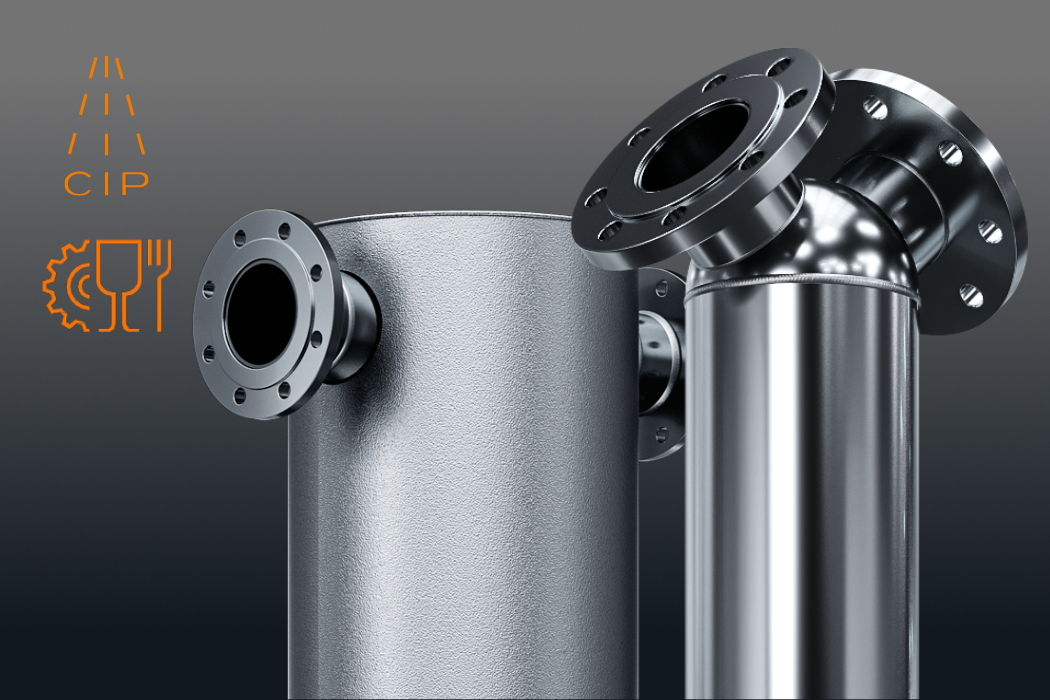
Photo source: Hexonic